

Why the Skincare Conversation Has Changed
Skincare is everywhere now. The hashtag #SkincareRoutine has over 23 billion views on TikTok. What was once a quiet corner of beauty has become a global cultural movement, with brands competing for attention, trust, and loyalty. Research into the skincare market, valued at $133.9 billion in 2018, is forecast to reach $198.35 billion by the end of 2025.
But this growth isn’t only about more moisturisers on the shelf. Consumers are more informed, socially connected and selective than ever. Social platforms have turned ingredient labels into mainstream conversation. Shoppers, men and women alike now look for sophisticated formulas that meet their specific needs, feature elegant, transparent ingredients and align with personal values.
Authenticity has become the defining word of the decade. As knowledge spreads, consumers hold brands and their ambassadors accountable. “Greenwashing,” where companies exaggerate eco-friendly credentials, has eroded trust. Gen Z, in particular, demands honesty. According to TelmarHelixa’s Gen Z Insights Report, 40% of this generation expect the brands they buy to actively support social causes, while Deloitte data shows that 64% will pay more for products that are safe for the environment.
To reach them, skincare brands must go beyond marketing slogans; they must live their values and prove their purpose.
Who Is Today’s Skincare Consumer and What Do They Care About?
TelmarHelixa Discover provides a detailed view of today’s skincare audience, combining demographic, psychographic and lifestyle data to reveal the mindsets behind the market.
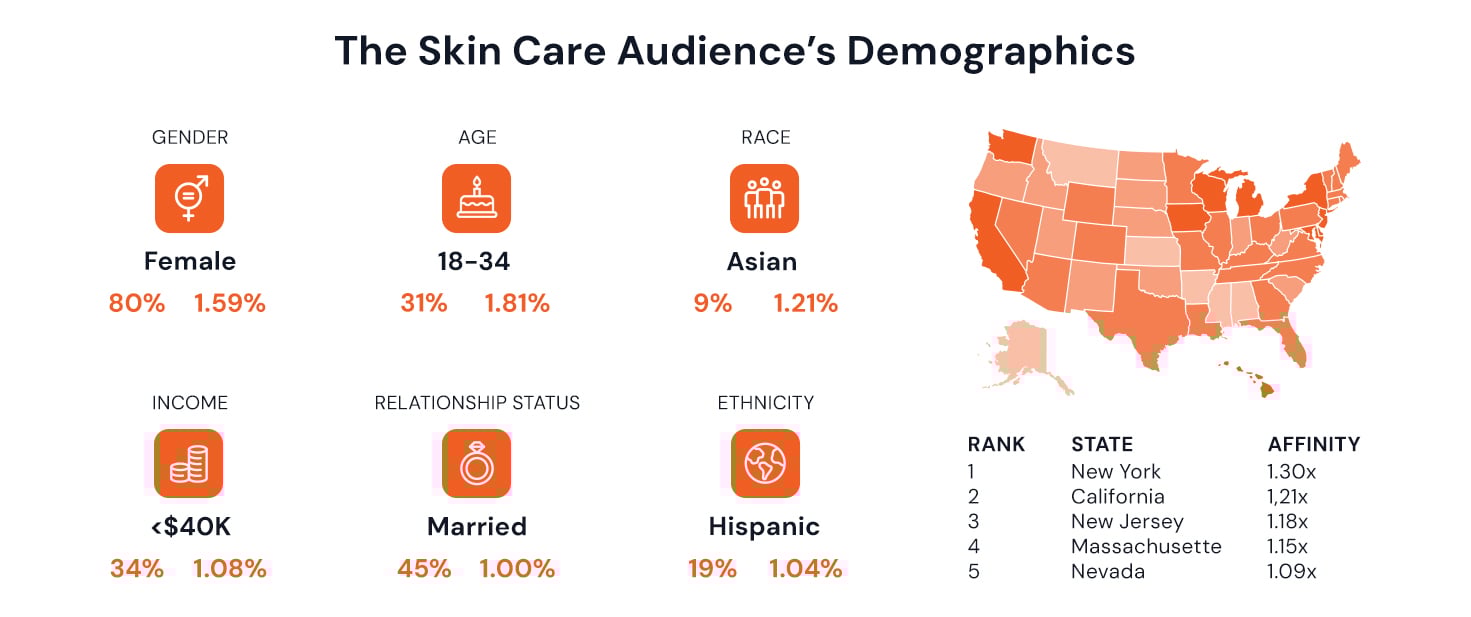 The Core Skincare Demographics
- Female – 83% || 1.65×
- 18–34 years old – 38% || 1.21×
- Single – 42% || 1.03×
- Make < $40K a year – 33% || 1.11×
- Asian – 9% || 1.17×
- Hispanic – 20% || 1.05×
Top States
- New York – 1.21×
- California – 1.16×
- New Jersey – 1.12×
- Illinois – 1.11x
- Massachusetts – 1.08x
At first glance, the skincare audience appears youthful, but interest spans every generation. Each age group grew up with different hero products and develops loyalty accordingly.
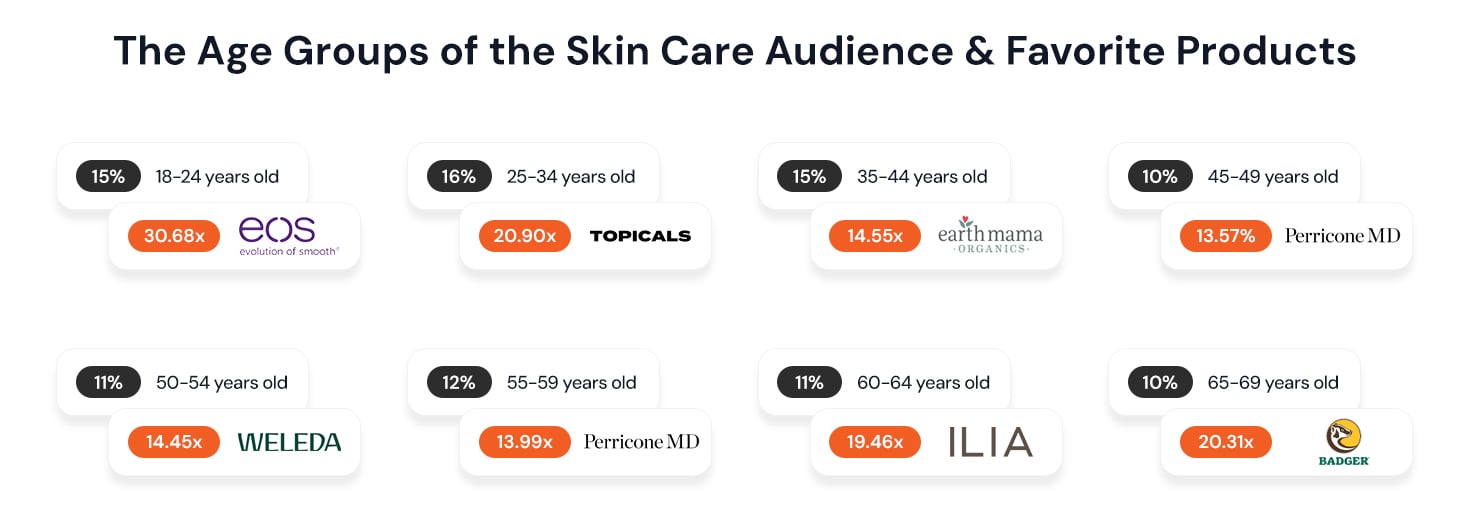 Age and Brand Loyalty: How Each Generation Shops for Skin Care
- 18–24 years old – 17% || eos – 21.57×
- 25–34 years old – 21% || Fenty Skin – 13.22×
- 35–44 years old – 16% || The Honest Company – 9.31×
- 45–49 years old – 8% || Aveda – 9.80x×
- 50–54 years old – 9% || Aveda – 10.38×
- 55–59 years old – 10% || L’Occitane – 12.00×
- 60–64 years old – 10% || Eucerin – 12.31×
- 65–69 years old – 9% || Eucerin – 14.55×
For skincare marketers, this diversity highlights opportunity. Generational preferences reveal not only brand affinity but also messaging nuance: younger buyers respond to community and inclusion, while older audiences value efficacy and longevity.
Are Skincare Buzzwords Still Building Trust or Just Noise?
The most popular buzzwords in skincare marketing are everywhere — “vegan,” “sustainable,” “organic,” “clean,” “hypoallergenic,” “natural,” “cruelty-free,” “dermatologist-tested” — and the list keeps growing. Retailers such as Sephora even dedicate entire categories such as “Clean at Sephora,” highlighting products that exclude parabens, sulfites, mineral oils and other harmful chemicals.
But while these words dominate packaging and social media, modern consumers are far more discerning. They don’t just look for the right labels; they want proof behind the promise. Education, transparency and ingredient literacy have made it easier for shoppers to spot empty claims. Buzzwords once used to signal trust now risk losing meaning if they aren’t backed by genuine action.
Why Sunscreen Represents a Cultural Shift in Skincare Marketing
Sunscreen has become one of the most talked-about skincare products this year, and not just because of its health benefits. It’s an example of how a simple item can carry cultural and environmental significance. According to data from Telmar Helixa’s partnership with MRI-Simmons Total Consumer View, 60% of women use skincare products that contain sunscreen and 52% follow a consistent skincare routine.
This growing attention has made sunscreen a symbol of conscious beauty. From reef-safe formulations that protect marine life to sunscreens designed for melanin-rich skin tones, brands are expanding inclusivity and responsibility in equal measure. For many consumers, protecting their skin now also means protecting the planet, and that dual awareness has reshaped what it means to be a modern beauty brand.
Key takeaway:
Buzzwords can open the door to awareness, but authenticity keeps it open. Skincare brands that back their claims with transparency and meaningful action build credibility that lasts longer than a marketing trend.
How Consumers Connect Skin Health With Planet Health
The skincare market has matured alongside consumer consciousness. More people now weigh both personal wellbeing and planetary impact when choosing products. According to Total Consumer View, 57% of skincare buyers choose natural products out of concern for personal and family health, while 54% do so because of environmental concern.
The Skin Care Audience’s Buying Styles (Agree Completely)
- “I buy natural products because I am concerned about me and my family’s health.” – 57% || 1.08×
- “I buy natural products because I am concerned about the environment.” – 54% || 1.08×
These behaviors reflect a shift from luxury to literacy. Consumers research, review and reward transparency. Brands perceived as performative risk being filtered out.
TelmarHelixa identifies a Health-Conscious and Social-Activist Audience that is 2.5× more likely to engage with skincare content. These individuals expect alignment between product performance and purpose.
What Brands Like Glow Recipe Teach Us About Authentic Marketing
New entrants are capitalising on these expectations. Glow Recipe, founded in 2015, exemplifies the modern skincare success story. By 2021, the Korean beauty brand had surpassed $100 million in sales, fueled by social-media virality, colorful packaging, and a mission grounded in sustainability and positivity.
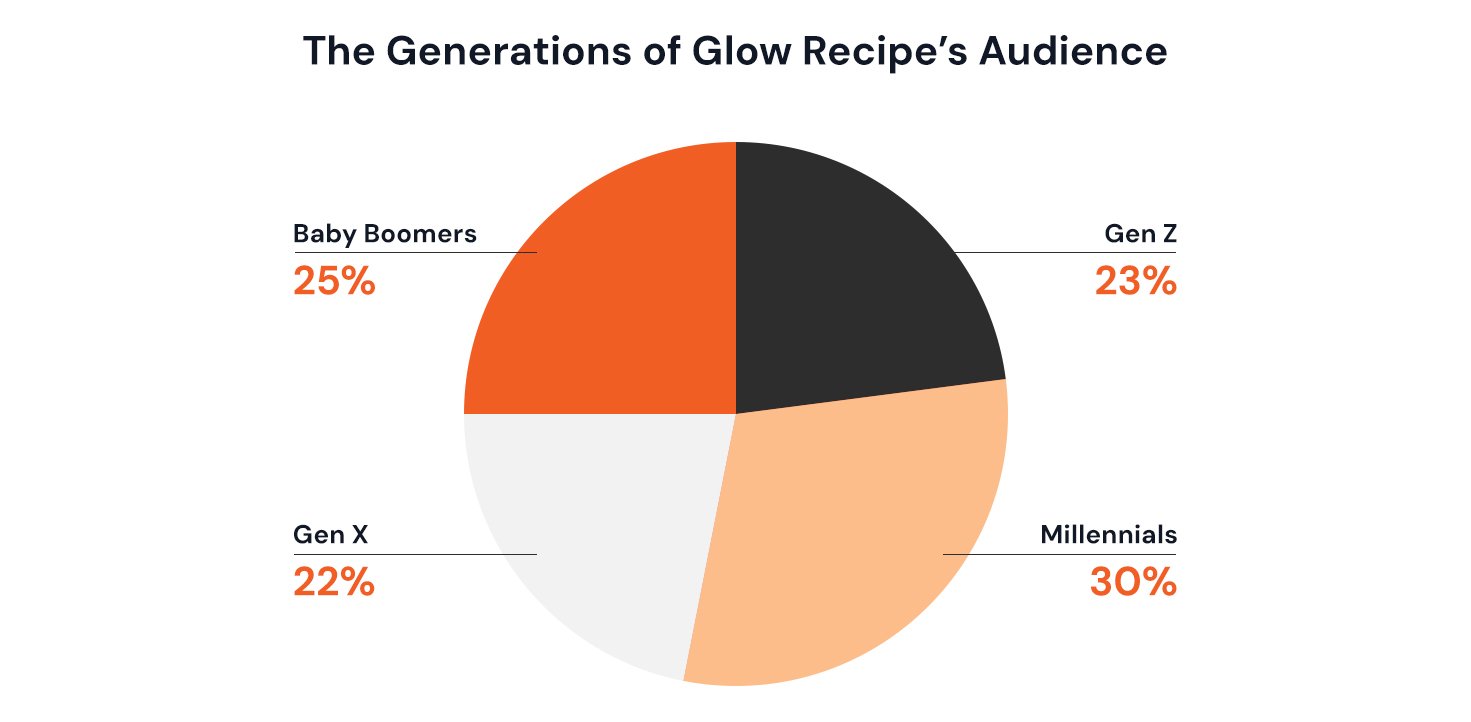
Glow Recipe’s philosophy, never using words like “poreless,” “perfect,” or “flawless”, positions the brand as a champion of realistic skin goals. Using TelmarHelixa’s audience-intelligence data, we find that Glow Recipe appeals across generations:
- Gen Z – 25%
- Millennials – 31%
- Gen X – 25%
- Baby Boomers – 19%
This even distribution demonstrates that authenticity transcends age. When values are visible and consistent, they create intergenerational loyalty, a key insight for marketers seeking long-term brand equity.
How Marketers Can Use Audience Intelligence to Win in Skincare
The skincare audience is vast and varied, but united by the expectation that brands must do what they say. Transparency, high-quality ingredients and measurable impact are non-negotiables.
Traditional market research provides a snapshot; audience insights provide a story. With TelmarHelixa Discover, marketers can explore not only who their audiences are, but why they behave the way they do, connecting social behaviour, cultural trends and lifestyle motivations into one actionable view.
Unlike basic social listening, Helixa transforms raw signals into enriched insights, revealing the multiple dimensions of human intent. In just a few clicks, marketers can see how their target audiences feel, what they care about and which topics will shape next quarter’s campaigns.
FAQs: Understanding the Skincare Consumer in 2026
- What trends are shaping skincare marketing in 202?
Sustainability, ingredient transparency, and inclusivity dominate. Consumers expect safe, effective and ethical products, supported by visible proof of responsibility. - How has Gen Z changed beauty marketing?
They’ve redefined trust. Gen Z expects brands to educate, not advertise, using facts, social proof and authentic engagement instead of slogans. - Why is sunscreen a key consumer focus?
It combines wellness, inclusivity and environmental awareness. From reef-safe ingredients to universal SPF tones, sunscreen reflects broader cultural change. - How can marketers use data more effectively?
By combining TelmarHelixa’s behavioral and psychographic insights, marketers can map emotional drivers, connecting what audiences say, do and believe into actionable strategy. - What defines an authentic skincare brand in 2026?
Transparency, traceability and tone. Consumers don’t expect perfection; they expect proof.
Conclusion: Where Data Meets Authenticity
The skincare category is no longer defined by demographics, but by depth of purpose, transparency and connection. As consumer expectations evolve, marketers must evolve too, using data to listen, adapt and communicate authentically.
TelmarHelixa’s insights reveal that the future of skincare belongs to brands that balance innovation with integrity. When marketers use intelligence not only to target but to understand, every campaign becomes more human and every message more meaningful.
Our latest market research report "Mapping the Modern Customer: Gen Z and Millennials in Focus", evidences meaningful differences between GenZ and Millennials, market by market, platform use, creator ecosystems, values alignment and purchase pathways, helping marketers to do just that - understand. The outcome is strategy that travels globally and flexes locally, with the granularity to act in each market.
Download your copy of TelmarHelixa's Gen Z and Millennials in Focus Research Report here.