

Patagonia’s enduring success lies in its ability to align purpose with precision. This analysis explores the Patagonia target audience demographics and how customers perceive Patagonia, using TelmarHelixa’s Discover first-party social behavioural audience insights
Key Insights at a Glance
- Patagonia’s target market blends environmentally conscious, active and premium consumers, unified by shared values.
- Core audience segments include Outdoor Enthusiasts, Eco-Conscious Consumers, Premium Lifestyle Shoppers and Next-Gen Advocates.
- Demographics skew toward adults aged 35–54, slightly more male, with household incomes above $100K and a strong presence in outdoor-oriented regions of the U.S.
- Customers see Patagonia as authentic, responsible and performance-driven.
- Purpose-led positioning backed by data continues to drive long-term brand loyalty.
From Mountain Peaks to Global Consciousness
Patagonia is a premium outdoor apparel company renowned for its commitment to environmental activism, high-performance gear and purpose-driven business model.
Patagonia’s audience isn’t defined by geography; it’s defined by shared values. Discover’s audience analysis reveals how data-driven insight explains the brand’s loyalty, its distinct customer profile and its sustained cultural relevance.
The Patagonia Target Market: Values That Drive Loyalty
Patagonia’s target market blends environmental awareness with active lifestyles. The brand appeals to consumers who prioritize sustainability, performance and authenticity; people who don’t just buy products, but buy into a mission.
From Discover’s social behavioural data, Patagonia’s target market is defined by:
- Ethical consumption — shoppers who align with eco-friendly production and transparency.
- Active living — outdoor sports and fitness are central to their identity.
- Premium mindset — customers who prefer durability and responsible luxury.
- Cultural alignment — loyalty built through trust, repair initiatives and shared purpose.
These consumers live everywhere, from coastal cities to mountain towns, united by values that transcend geography.
Patagonia Target Audience Profiles
Discover’s data reveals four primary Patagonia audience segments, each contributing to the brand’s strength.
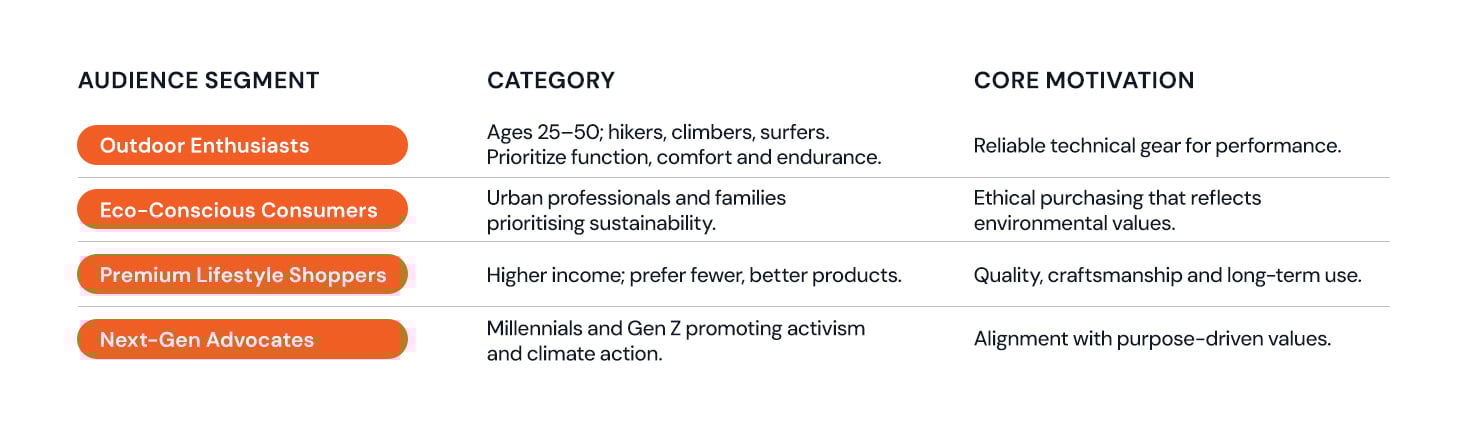
This segmentation demonstrates Patagonia’s ability to appeal to both established professionals and younger consumers who see the brand as part of their identity.
Patagonia Demographics: Who They Are
Age and Gender Distribution
Patagonia’s audience shows strong representation among adults aged 35–54, accounting for more than 40% of the brand’s U.S. fan base. Younger consumers aged 25–34 show rising engagement, signalling long-term relevance.
From a gender perspective, males dominate with 55% (Affinity 1.10x) of the audience share (above the U.S. online baseline), although women form a growing, high-influence demographic.

Income
Patagonia customers typically report household incomes above $100,000, aligning with the brand’s premium positioning and durable-goods philosophy.
Geography
Patagonia’s largest audience clusters include:
- Boulder, CO
- Denver, CO
- Seattle, WA
- New York City, NY
- San Francisco, CA
These regions combine outdoor accessibility with environmentally engaged populations, ideal alignment for Patagonia’s mission.
Patagonia’s audience’s interests are focused on outdoor athletic clothing and equipment. Some more recognizable brands and organizations that have high affinity among Patagonia fans include Petzl, Salomon, The North Face, and GORE-TEX.
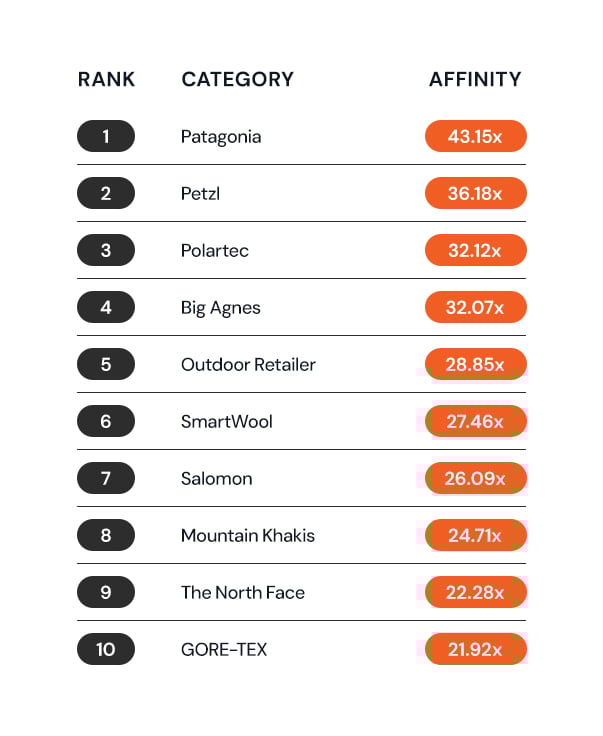
Observed consumer interests are expressed as the Affinity Index, which measures how the target audience you are analyzing is different from the average American adult.

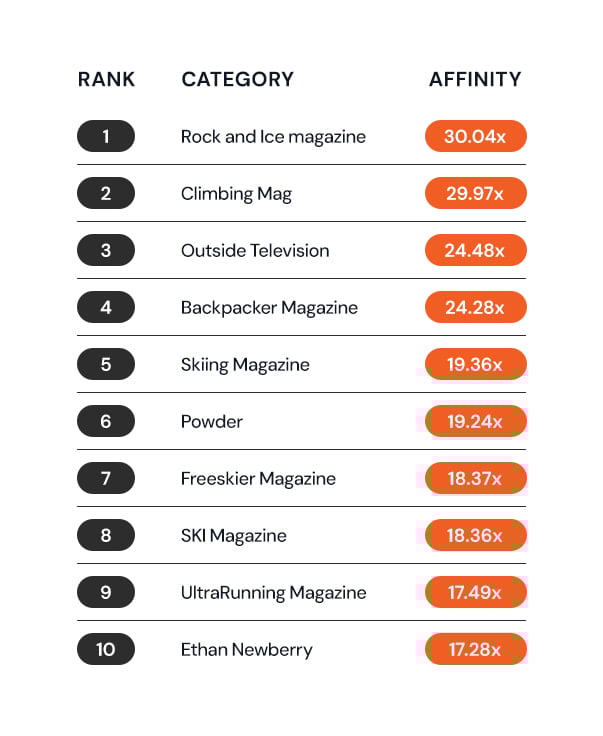
A similar trend can be seen through the audience’s choice of media. Publications that focus on outdoor sports such as skiing and climbing feature prominently in the top 10 list.
Patagonia’s audience uses apps that support their healthy, active lifestyles. Fitness apps such as Strava and Nike+ Run Club are a natural match for those who love to get outdoors and exercise regularly. Photo inspiration apps also feature alongside travel and mental wellbeing tools, giving us a deeper insight into the audience’s holistic approach to a healthy body and mind.
Patagonia Customer Demographics: Beyond Numbers
Demographics reveal who customers are; psychographics show why they connect.
Discover’s social behavioral first-party data identifies Patagonia customers as more likely to:
- Support environmental and outdoor organizations such as the Sierra Club and National Park Foundation.
- Follow outdoor and sustainability-focused media.
- Engage with brands advocating circular consumption and repair culture.
This audience sees Patagonia as part of a value ecosystem where buying responsibly signals belonging to a community of purpose.
How Do Customers Perceive Patagonia?
Customer perception defines Patagonia’s brand power. TelmarHelixa’s analysis shows customers perceive Patagonia as:
- Authentic and transparent: a brand that lives its mission.
- Functionally excellent: premium gear that performs and lasts.
- Socially responsible: re-investing profits into environmental causes.
This perception builds exceptional loyalty. Customers often reference the brand’s repair programmes, activism and honesty as reasons for advocacy. In a market wary of greenwashing, Patagonia stands as a benchmark for genuine purpose-led business.
Lessons for Brands: Why Patagonia’s Market Strategy Works
Patagonia shows how deep audience understanding becomes a long-term growth driver. Its success reflects alignment between customer values, product design and corporate behavior.
Lead with Data, Act with Purpose
Patagonia turns audience intelligence into meaningful action. Knowing its customers prioritize environmental integrity, it reinvests profits in conservation, limits product drops and champions repair over replacement. Data-led empathy drives loyalty more effectively than traditional marketing.
Build Communities, Not Just Customers
Patagonia’s audience behaves more like a network than a segment. Campaigns such as Worn Wear and Don’t Buy This Jacket invite participation, not passive purchase. These advocacy loops create long-term engagement that paid advertising rarely achieves.
Balance Performance and Principle
Values attract attention; quality sustains it. Patagonia maintains technical credibility across outdoor and everyday categories, ensuring ethics never replace engineering. That balance of purpose and performance converts awareness into retention.
Treat Transparency as a Growth Driver
Transparency is Patagonia’s most effective differentiator. Public supply-chain data, carbon-neutral pledges and the founder’s transfer of ownership to a climate trust all reinforce leadership through honesty. The result: scrutiny becomes admiration.
What Other Brands Can Learn
- Use first-party data to uncover belief systems, not just demographics.
- Align corporate actions with those beliefs before amplifying them through campaigns.
- Measure success in advocacy and trust, not just conversions.
Frequently Asked Questions
Who is Patagonia’s target market?
Environmentally conscious, active consumers who value sustainability, performance and authenticity in premium outdoor apparel.
What are Patagonia’s customer demographics?
Primarily ages 35–54, slightly more male than female, with household incomes above $100,000. Key regions include Boulder, CO, Denver, CO, Seattle, WA, New York City, NY, San Francisco, CA
How do customers perceive Patagonia?
As authentic, purpose-driven and reliable. A company that prioritizes sustainability and community over short-term profit.
Why does Patagonia appeal to Gen Z and Millennials?
Younger consumers connect with Patagonia’s activism and environmental mission, seeing it as both socially conscious and lifestyle-relevant.
What can other brands learn from Patagonia’s audience strategy?
Lead with transparency, use data to understand shared values and make ethics part of both the business model and brand message.
Conclusion: Where Performance Meets Understanding
Patagonia’s brand is built on more than performance; it’s built on understanding. Patagonia’s fusion of insight-driven strategy and authentic purpose continues to set the standard for brands seeking growth and trust in intelligent markets.
TelmarHelixa Discover’s social behavioral data shows that when a company knows its target audience deeply, their demographics, motivations and values, it creates more than market share; it creates community.
Our latest market research report "Mapping the Modern Customer: Gen Z and Millennials in Focus", evidences meaningful differences between GenZ and Millennials, market by market, platform use, creator ecosystems, values alignment and purchase pathways, helping marketers to do just that - understand their audience deeply. The outcome is strategy that travels globally and flexes locally, with the granularity to act in each market.
Download your copy of TelmarHelixa's Gen Z and Millennials in Focus Research Report here.