

There is an obvious temptation when marketing around sports... talk about sports.
But some of the most interesting opportunities for brands emerge when you stop looking exclusively at what happens on the field.
Because NFL fans aren't just football fans. They're travelers. Gamers. Parents. Fashion consumers. Technology buyers. Pet owners. Entertainment fans. Finance customers.
And understanding those overlapping identities can tell marketers far more than fandom alone.
The 2026 TelmarHelixa NFL Fan Report examined the interests, brands, media and personalities that sit alongside football in fans' lives. The results demonstrate just how multidimensional this audience really is.
Football fandom doesn't stop at sports media
NFL fans naturally overindex across sports-related media.
The report highlights ESPN, NFL Network and MLB Network among sports channels, alongside shows such as SportsCenter, College GameDay and First Take.
Podcasts including Pardon My Take, Club Shay Shay and New Heights also appear prominently, while sports magazines and bookmaker sites add additional environments where NFL audiences engage.
But that's only part of their media life.
Streaming has fundamentally changed how sports fits into the entertainment ecosystem.
Fans increasingly move between live games and the broader streaming, social and digital environments surrounding them.
That means the opportunity isn't confined to the game window.
Follow the passion points
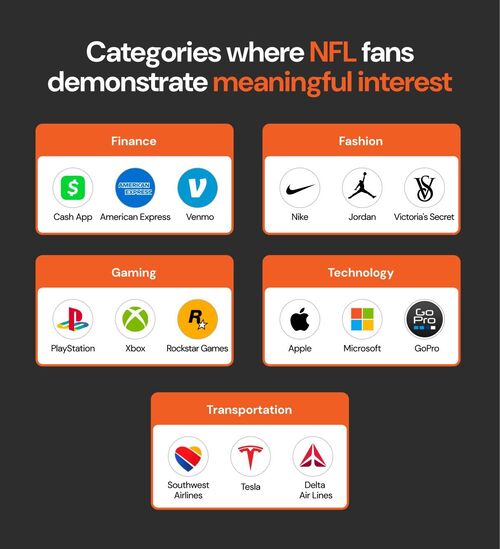
The report identifies several product and service categories where NFL fans demonstrate meaningful interest.
-
In finance, brands include Cash App, American Express and Venmo.
-
In apparel and fashion: Nike, Jordan and Victoria's Secret.
-
Gaming includes PlayStation, Xbox and Rockstar Games.
-
Transportation includes Southwest Airlines, Tesla and Delta Air Lines.
Look at that list again.
Finance. Fashion. Gaming. Technology. Travel.
Suddenly, an NFL audience strategy has become much bigger than football.
Female NFL fans make the point even clearer
One of the most interesting audiences examined in the report is female NFL fans.
Their top teams include the Dallas Cowboys, New England Patriots and Kansas City Chiefs, while Travis Kelce, Patrick Mahomes and Aaron Rodgers appear among their leading players.
But look beyond football and the audience becomes significantly more nuanced.
Starbucks, Target and Sephora appear among leading brands.
People Magazine and E! News sit alongside ESPN among media preferences.
And the leading psychographic groups include Conscientious Parents, Pet Adopters, Beauty & Wellness Aware, Fashion Lovers and Travelers.
This is where audience intelligence starts changing creative strategy.
A brand doesn't necessarily have to communicate with this audience by putting a football in every advertisement.
Football can provide the cultural connection.
Parenting, pets, beauty, fashion, travel or entertainment might provide the creative idea.
Which NFL audience fits your brand?
The same principle can be taken another level deeper.
The report looks at affinities between NFL team audiences and broader categories.
Among fans engaging with sports sites, for example, Carolina Panthers fans show 2.06x affinity, followed by Jacksonville Jaguars fans at 1.88x and Indianapolis Colts fans at 1.86x.
For podcasts, Buffalo Bills fans lead at 1.77x.
And among sports channels, Jacksonville Jaguars fans reach 2.33x affinity, followed by New York Jets fans at 2.30x and Los Angeles Rams fans at 2.28x.
Similar differences emerge across restaurants and cafés, finance, transportation, travel and beverages. That means brands can flip the traditional sponsorship question around.
Instead of asking:
"Which NFL team should we sponsor?"
Ask:
"Which NFL team's audience looks most like the people our brand wants to reach?"
That is a very different starting point.
Find the overlap
Modern audience strategy increasingly happens at intersections.
-
Football + fashion.
-
Football + gaming.
-
Football + finance.
-
Football + travel.
-
Football + parenting.
-
Football + entertainment.
Those intersections can help brands find more authentic ways to participate in sports culture.
While football might be what brings the audience together, understanding everything else they care about is what can help a brand build a meaningful connection.