

The Road to 2026: Understanding the World Cup Through Consumer Intelligence
The FIFA World Cup is more than the world's largest sporting event. It is a global cultural phenomenon that shapes media consumption, brand engagement, consumer behavior, and national identity on a scale few events can match.
As the world turns its attention toward the 2026 FIFA World Cup, hosted jointly by Canada, the United States, and Mexico, TelmarHelixa Discover is launching a new content series dedicated to exploring the intersection of football fandom, marketing, advertising, and consumer intelligence. The tournament marks a historic milestone as the first World Cup hosted by three nations and the first to feature 48 teams, creating unprecedented opportunities for brands, advertisers, and media planners to engage audiences across North America and beyond.
Over the coming weeks, we will use Discover to examine:
- How football fandom differs across countries and cultures
- The brands, media, and behaviors that unite global supporters
- Emerging audience segments surrounding the tournament
- The economic and marketing impact of the world's biggest sporting event
- How advertisers can activate against one of the largest audiences ever assembled
Part One: The Faces of Football in the Host Nations
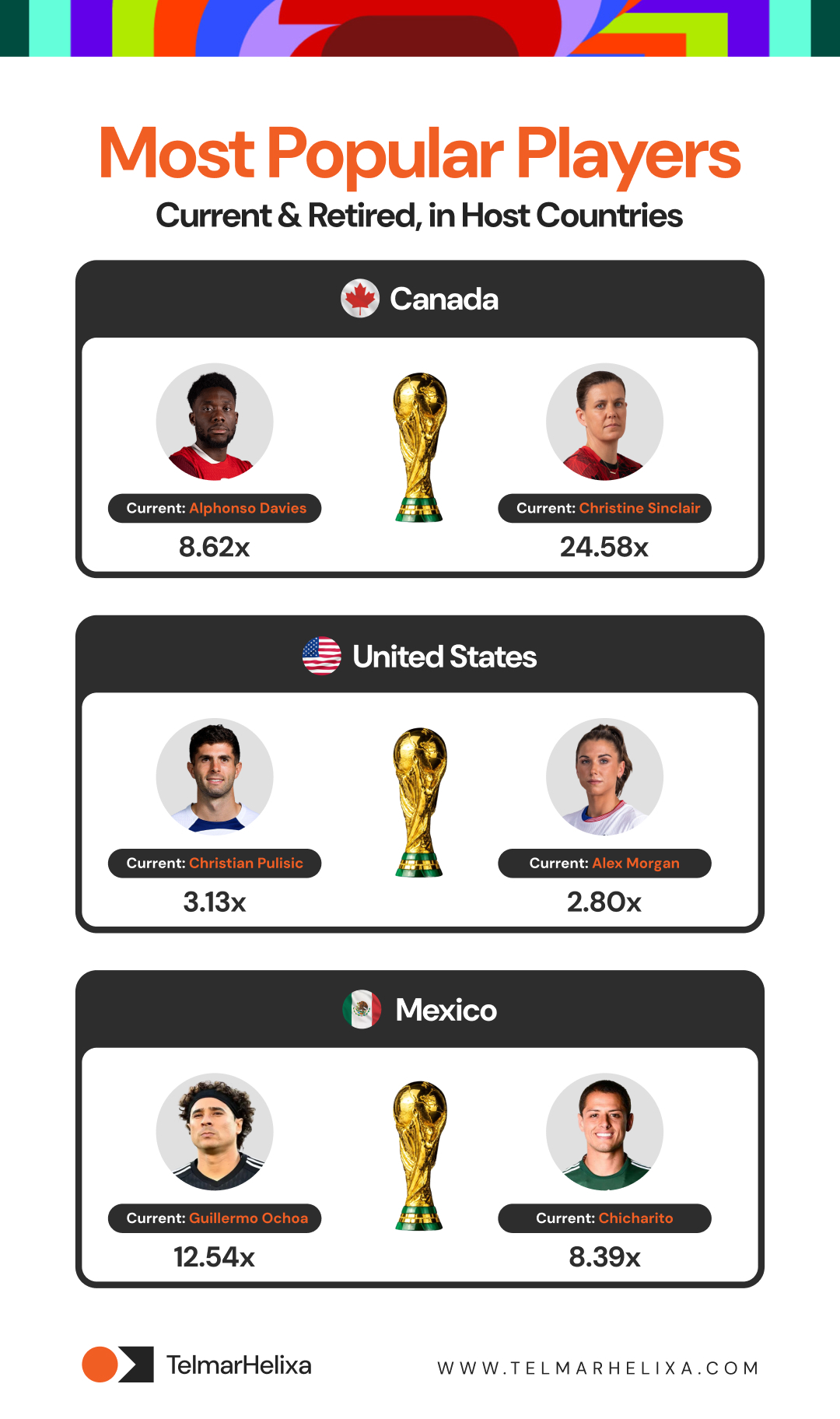
Every World Cup host country brings its own football identity to the global stage. To understand those identities, we examined the most popular current and retired football players across the three host nations.
Canada: A New Generation Built on a Legendary Foundation
Canada's football story reflects both its future and its history.
Today, no player resonates more strongly with Canadian football fans than Alphonso Davies, whose popularity indexes at 8.62x among Canadian supporters. As one of the most recognizable stars in world football, Davies represents Canada's emergence as a growing force on the international stage.
Yet Canada's most beloved football icon remains Christine Sinclair, posting an extraordinary 24.58x affinity. Sinclair's influence extends well beyond the pitch. As one of the greatest players in the history of the women's game, she helped transform soccer's visibility and popularity across the country.
The contrast between Davies and Sinclair highlights a fascinating dynamic: Canada's football culture is being shaped simultaneously by an exciting men's future and a women's legacy that continues to define the sport nationally.
United States: Mainstream Recognition Meets Global Ambition
In the United States, Christian Pulisic leads among current players with a 3.13x affinity.
Often referred to as the face of modern American soccer, Pulisic represents the continued growth of football within an increasingly crowded sports landscape. His popularity reflects the sport's expanding relevance among younger audiences and multicultural communities.
Among retired players, Alex Morgan remains one of the most recognizable names in American soccer, indexing at 2.80x. Morgan's impact extends beyond athletic achievement. She helped elevate the visibility of the U.S. Women's National Team while becoming one of the most marketable athletes in American sports.
Together, Pulisic and Morgan demonstrate how American soccer fandom continues to be shaped by both men's and women's success, creating a uniquely balanced football culture.
Mexico: Tradition, Passion, and National Heroes
Few countries embrace football with the intensity found in Mexico.
Current player Guillermo Ochoa stands as the nation's most popular active footballer, posting a remarkable 12.54x affinity. Across multiple World Cups, Ochoa has delivered iconic performances that have cemented his place as one of Mexico's most celebrated athletes.
Among retired players, Javier "Chicharito" Hernández continues to command an impressive 8.39x affinity. As Mexico's all-time leading scorer and one of the country's most recognizable sporting figures, Chicharito remains deeply connected to Mexican football culture.
Together, Ochoa and Chicharito illustrate the enduring power of national pride within Mexican football fandom. Their popularity demonstrates how the sport serves as a powerful expression of identity and community.
What This Means for Marketers
While these athletes may play the same sport, they represent very different audience narratives.
In Canada, football fandom is deeply connected to national growth and the legacy of women's sport.
In the United States, fandom reflects the continued mainstream expansion of soccer across diverse audiences.
In Mexico, football remains a cultural cornerstone where players become enduring national symbols.
Understanding these nuances is critical for brands preparing for the World Cup. Successful campaigns will go beyond broad sponsorships and media buys. They will recognize that football fans are not a single audience. They are distinct communities shaped by culture, history, identity, and passion.
As the countdown to kickoff continues, marketers have a unique opportunity to understand not just who football fans are, but why they engage.
Coming Next
In our next installment, we will examine how World Cup fans consume media across North America, exploring the platforms, channels, and content environments that brands should prioritize as the tournament approaches.
Because understanding the World Cup starts with understanding the people who make it matter.