
“When you understand your audience properly, better decisions follow.”
You can build sharper segments. You can create more relevant messaging. You can choose stronger media channels. You can spot growth opportunities faster. And you can avoid the common mistake of assuming that a broad target audience all thinks, behaves or buys in the same way.
That is where audience profiling comes in.
Audience profiling helps teams build a clearer, more detailed picture of the people they want to reach. It looks beyond basic demographics and starts to answer the questions that matter most: who your audience is, what they care about, how they behave, where they spend time, what influences them and what might move them to act.
For brands, agencies and media teams, this kind of understanding is no longer a nice-to-have. Audiences are more fragmented. Media habits are more complex. People expect more relevant experiences. And campaign investment needs to work harder.
At TelmarHelixa, audience profiling is central to how we help teams understand people with greater depth and precision. This guide explains what audience profiling is, why it matters, what a strong audience profile should include and how to build profiles that can support strategy, creative, segmentation and media planning.
What is audience profiling?
Audience profiling is the process of building a detailed picture of a specific audience using data, research and behavioural insight. A strong audience profile helps teams understand who an audience is, what they care about, how they behave, where they spend time and how best to reach them.
In simple terms, audience profiling turns audience data into a more strategic understanding of people.
It helps answer questions such as:
- Who are we trying to reach?
- What do they have in common?
- What makes them different from other groups?
- What do they care about?
- What motivates their decisions?
- What barriers might stop them from acting?
- Which brands, creators, media channels or communities influence them?
- Where should we invest to reach them effectively?
Audience profiling is not about creating a neat description for a slide deck. It is about building a practical view of the audience that can shape real decisions.
The best audience profiles are clear, evidence-based and actionable. They help teams move from broad assumptions to a more human understanding of the audience.
Why audience profiling matters
Audience profiling matters because most audiences are more complex than they first appear.
A target audience such as “Gen Z consumers,” “sports fans,” “new parents,” “business decision-makers” or “luxury travellers” may sound specific, but each of those groups contains many different motivations, behaviours and media habits.
Without profiling, teams can easily fall into generalisation. They may create messaging that feels too broad. They may choose channels based on assumption rather than evidence. They may overlook high-value audience groups. Or they may spend budget reaching people in places where they are not especially receptive.
Audience profiling helps bring that audience into focus. It can help teams:
Understand people beyond demographics
Demographics are useful, but they rarely tell the whole story.
Age, gender, income, region and household status can help describe an audience. But they do not always explain what people care about, what influences them or why they behave in a certain way.
Two people may look similar demographically but have very different lifestyles, media habits and purchase motivations.
Audience profiling helps you understand those deeper differences.
Improve audience segmentation
Audience profiling and audience segmentation work closely together.
Segmentation helps divide a wider audience into meaningful groups. Profiling helps explain those groups in more detail.
A segment tells you which group you are looking at.
A profile helps you understand what that group is like.
For example, an audience segment might be “frequent travellers aged 25-44.” The audience profile would go further. It might show that this group values convenience, follows travel creators, over-indexes on podcasts, responds to loyalty rewards and is more likely to book when messaging focuses on flexibility and experience.
That level of detail is what makes the segment usable.
Create more relevant messaging
Audience profiling helps teams understand what to say and how to say it.
Different audiences respond to different messages. Some need proof. Some need reassurance. Some need inspiration. Some care about price. Others care about quality, identity, convenience, sustainability or status.
Without profiling, messaging can become too generic.
With profiling, creative and content teams can build messages around real audience needs, motivations and decision triggers.
Strengthen media planning
Audience profiling also improves media planning.
It helps teams understand where an audience spends time, which channels they use, what content they consume and which media environments are most likely to influence them. That makes it easier to plan campaigns around audience behaviour rather than channel assumptions.
A strong audience profile can show whether a group is more reachable through TV, digital video, social, audio, print, out-of-home, podcasts, creators or a combination of channels. For cross-channel planning, this matters.
The more clearly you understand the audience, the easier it becomes to choose the media mix that gives your campaign the best chance of being noticed, remembered and acted on.
Spot growth opportunities
Audience profiling can also reveal opportunities that are easy to miss.
It may show that a brand is resonating with an unexpected group. It may reveal an emerging interest within an existing audience. It may uncover a segment with high purchase intent but low current brand engagement. Or it may show that one audience group is more valuable than its size suggests.
These insights can help teams identify new markets, improve targeting and build more effective campaign strategies.
Audience profiling vs audience segmentation
Audience profiling and audience segmentation are closely related, but they are not the same thing.
| Term | What it means | Why it means |
| Audience profiling | Building a detailed picture of a specific audience using data, research and behavioral insight. | Helps teams understand who the audience is, what they care about and how to reach them. |
| Audience segmentation | Dividing a wider audience into smaller groups based on shared characteristics, behaviours or needs. | Helps teams decide which groups to prioritise and target. |
| Audience analysis | Interpreting audience data to identify patterns, opportunities and differences |
Helps teams turn raw data into usable insight. |
| Audience intelligence | Using data, technology and research to understand audiences at scale. | Helps teams make faster, more evidence-led decisions about strategy, media and campaigns. |
The simplest way to think about it is this:
Segmentation divides the audience. Profiling explains the audience. Analysis interprets the data. Audience intelligence brings the whole process together.
What should an audience profile include?
A useful audience profile should be detailed enough to guide decision-making, but not so complicated that nobody uses it.
The goal is to create a practical profile that helps teams understand the audience quickly and act with confidence.
A strong audience profile usually includes:
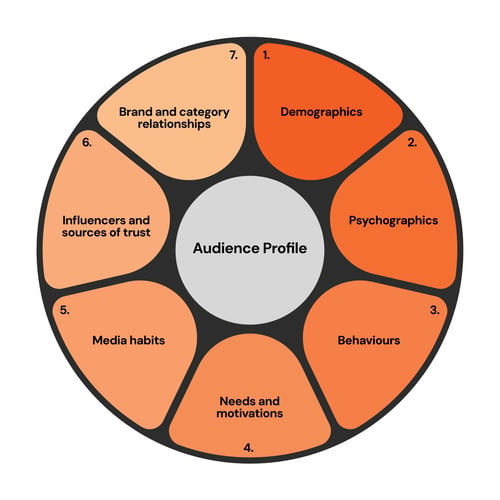
1. Demographics
Demographics help describe who the audience is.
This can include:
- Age
- Gender
- Location
- Income
- Education
- Employment status
- Household size
- Relationship status
- Presence of children
- Life stage
Demographic data is often the starting point for audience profiling. It helps teams understand the basic composition of the audience and compare one group with another.
But demographics should not be the end point.
They are most useful when combined with richer behavioural, psychographic and media data.
2. Psychographics
Psychographics help explain how an audience thinks and what they care about.
This can include:
- Interests
- Attitudes
- Values
- Beliefs
- Lifestyle choices
- Personality traits
- Aspirations
- Motivations
- Opinions
- Cultural preferences
Psychographic insight is especially valuable because it helps teams understand why people behave the way they do.
For example, a brand may know that two audience groups are both interested in fitness. But one group may be motivated by performance and competition, while another is motivated by wellbeing, confidence and routine.
Those differences matter. They influence messaging, creative direction, channel choice and campaign tone.
3. Behaviors
Behavioral data helps show what an audience actually does.
This can include:
- Purchase behavior
- Product usage
- Brand interactions
- Website visits
- Search behavior
- Content engagement
- App usage
- Loyalty activity
- Review behavior
- Social engagement
- Event attendance
- Subscription behavior
Behavior is often one of the most useful inputs for audience profiling because it is based on actions rather than assumptions.
It helps teams understand how an audience discovers, evaluates, buys, uses and engages with products or services.
4. Needs and motivations
A good audience profile should explain what the audience wants and why.
This can include:
- Functional needs
- Emotional needs
- Purchase motivations
- Decision triggers
- Barriers to action
- Pain points
- Desired outcomes
- Sources of reassurance
- Reasons to choose or reject a brand
This is where audience profiling becomes especially useful for strategy and creative.
Knowing what an audience needs helps teams build messages that feel relevant and useful. Knowing what might stop them from acting helps teams remove friction.
5. Media habits
Audience profiling should include how and where an audience consumes media.
This can include:
- TV viewing
- Streaming behaviour
- Social media usage
- Digital video consumption
- Podcast listening
- Radio listening
- Print readership
- Out-of-home exposure
- Search behaviour
- Gaming behaviour
- Influencer engagement
- Device usage
- Time of day media patterns
Media habits are especially important for brands, agencies and media teams.
A profile that does not explain where the audience spends time is harder to activate.
The most useful audience profiles connect who the audience is with where they can be reached.
6. Influencers and sources of trust
Audience profiling should also consider who and what influences the audience.
This might include:
- Creators
- Celebrities
- Experts
- Friends and family
- Review sites
- Communities
- Publishers
- Social platforms
- Brands
- Cultural figures
- Professional networks
Influence is not the same for every audience.
Some groups are more influenced by creators. Others trust experts, peers, reviews, media brands or professional sources. Understanding this helps teams decide which partnerships, proof points or content formats may work best.
7. Brand and category relationships
A strong audience profile should show how the audience relates to your brand, category and competitors.
This can include:
- Brand awareness
- Brand perception
- Category usage
- Purchase frequency
- Loyalty
- Switching behaviour
- Consideration
- Barriers to purchase
- Competitor affinity
- Unmet needs
This helps teams understand where the audience sits today and what might need to change.
For example, an audience may know your brand but not understand your value. They may like the category but see no urgency to buy. They may be loyal to a competitor but open to switching if a specific need is met.
Audience profiling examples
Audience profiling becomes clearer when you see how it can be used.
Here are a few examples.
Example 1: A fitness brand
A fitness brand may have a broad target audience of adults interested in exercise.
Audience profiling could reveal several very different groups:
- Performance-focused athletes who care about progress, competition and measurable results
- Wellness-led exercisers who care about balance, confidence and long-term health
- Social fitness fans who are motivated by community and shared experiences
- Style-led consumers who see fitness as part of identity and lifestyle
Each profile would require different messaging, channels and creative.
The performance audience may respond to data, progress tracking and expert proof. The wellness audience may respond to reassurance and routine. The social audience may respond to community and events. The style-led audience may respond to creators, culture and visual identity.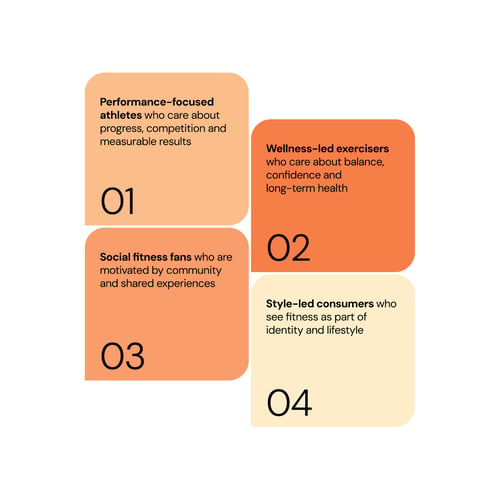
Example 2: A travel brand
A travel brand may profile its audience based on motivations and media behaviour.
One audience might be experience-led, looking for adventure, discovery and once-in-a-lifetime moments. Another might be convenience-led, looking for simple planning, reassurance and flexible booking. Another might be value-led, comparing deals and waiting for the right offer.
The same product could appeal to all three groups, but not with the same message.
Profiling helps the brand understand what each audience needs to hear before they act.
Example 3: A B2B technology company
A B2B technology company may target senior decision-makers, but that audience is not uniform.
Audience profiling could reveal:
- Strategic leaders who care about growth, risk and competitive advantage
- Operational leaders who care about efficiency, process and team adoption
- Technical evaluators who care about integration, security and performance
- Financial stakeholders who care about cost, value and measurable return
Each audience profile helps shape content, sales enablement, media targeting and nurture strategy.
Example 4: A media planning team
A media planning team may need to understand a target audience for a campaign.
Audience profiling could show that one segment is highly active on social video, follows specific creators and responds to entertainment-led content. Another segment may be more reachable through audio, print and trusted editorial environments. Another may be influenced by out-of-home exposure during commuting or shopping moments.
This insight helps the team build a more effective cross-channel media plan.
How to create an audience profile
Audience profiling works best when it follows a clear process.
Here is a practical five-step approach.
1. Define the audience and objective
Start with a clear question.
What audience are you trying to understand, and why?
The purpose of the profile should shape the data you collect and the way you interpret it.
You might be building an audience profile to:
- Launch a campaign
- Enter a new market
- Improve media planning
- Refine messaging
- Develop a product proposition
- Understand a category opportunity
- Support audience segmentation
- Improve customer experience
- Identify growth audiences
A profile built for media planning may need more detail on channel behaviour. A profile built for messaging may need more detail on motivations and barriers. A profile built for growth strategy may need more detail on size, value and market opportunity.
The clearer the objective, the stronger the profile.
2. Gather the right data
Audience profiling should combine different types of data.
Useful data sources include:
- Customer data
- CRM data
- Website analytics
- Campaign performance data
- Survey research
- Social and digital behavioural data
- Search data
- Sales feedback
- Customer interviews
- Reviews and community discussions
- Syndicated research
- Audience intelligence platforms
The best profiles usually combine what people say with what people do.
Survey data can show attitudes, needs and preferences. Behavioural data can show actions, habits and engagement. Media data can show where audiences spend time and how they can be reached.
Together, these sources create a more complete picture.
3. Identify meaningful patterns
Once the data is gathered, look for patterns.
The goal is not to include every possible fact about the audience. The goal is to identify the details that matter.
Ask:
- What does this audience have in common?
- What makes them different from other groups?
- What needs or motivations stand out?
- What media behaviours are distinctive?
- What channels over-index?
- What influences this audience?
- What barriers may stop them from acting?
- What should change in our strategy as a result?
This final question is important.
If an insight does not change a decision, it may not belong in the profile.
4. Build the audience profile
Once the meaningful patterns are clear, turn them into a profile that teams can use.
A practical audience profile might include:
| Profile section | What to include |
| Audience name | A simple, memorable name for the profile |
| Audience summary | A short explanation of who the audience is |
| Key demographics | Age, location, income, life stage or other relevant traits |
| Behaviors | Purchase, media, search, content or category behaviors |
| Motivations | What the audience wants and why |
| Barriers | What might stop the audience from acting |
| Media habits | Channels, platforms and content formats used |
| Influencers | Creators, experts, communities, brands or sources of trust |
| Messaging implications | What the brand should say or avoid saying |
| Planning implications | How this profile should shape channel and investment decisions |
The profile should be easy to read and practical to use.
A good audience profile gives teams a shared understanding of the audience. It should help strategy, creative, media, product and sales teams make more consistent decisions.
5. Validate and update the profile
Audience profiles should not be treated as permanent.
People change. Markets change. Media habits change. New platforms emerge. Economic conditions shift. Competitors move. Cultural signals evolve.
That means audience profiles need to be reviewed and updated.
Validation can include:
- Comparing the profile with campaign results
- Testing messaging against the audience
- Reviewing media performance
- Running additional research
- Checking whether behaviours have changed
- Comparing against new audience intelligence
- Gathering feedback from sales, customer or research teams
The best audience profiles are living tools. They should become sharper over time.
What makes a good audience profile?
A good audience profile is not just detailed. It is useful. It should help teams make better decisions.
Strong audience profiles are usually:
| Criteria | What it means |
| Evidence-based | Built using reliable data, not assumptions |
| Human | Written in a way that helps teams understand real people |
| Specific | Clear enough to distinguish this audience from another |
| Actionable | Useful for strategy, messaging, media planning or campaign decisions |
| Reachable | Connected to the channels and environments where the audience can be found |
| Current | Updated as audience behaviour and market conditions change |
| Commercially relevant | Linked to a clear business, brand or campaign objective |
The most useful profiles do not just describe the audience, they also show what to do next.
Common audience profiling mistakes
Audience profiling can lose value when it becomes too broad, too shallow or too disconnected from action.
Here are some common mistakes to avoid.
1. Stopping at demographics
Demographics are useful, but they are not enough on their own.
A profile that only includes age, gender and location will rarely explain what motivates the audience or how to reach them effectively.
2. Confusing profiling with personas
Audience profiles and personas can work together, but they are not the same thing.
A persona is often a simplified representation of an audience. An audience profile should be more evidence-led and data-rich.
Personas can be useful for storytelling. Profiles should be useful for decision-making.
3. Including too much irrelevant detail
More information does not always mean more insight.
A good audience profile should include the information that matters for the decision at hand. If a detail does not help with strategy, messaging, media planning or activation, it may not need to be included.
4. Building profiles nobody uses
Audience profiling should not end in a research document that sits untouched.
The profile should be built in a way that supports real work. It should help teams make decisions about campaigns, creative, media investment, content, product or customer experience.
5. Ignoring media behaviour
A profile that does not include media habits is harder to activate.
If you do not know where an audience spends time or which channels influence them, it becomes more difficult to turn insight into campaign planning.
6. Letting profiles become outdated
Audience behaviour changes quickly.
Profiles should be reviewed regularly, especially before major campaigns, market launches or strategic planning cycles.
Audience profiling questions to ask
The right questions can help turn audience profiling from a data exercise into a useful planning tool.
Here are some practical questions to ask.
Questions about who the audience is
- What is the audience’s basic demographic profile?
- Where are they located?
- What life stage are they in?
- What household, work or social context shapes their decisions?
Questions about what they care about
- What are their main interests?
- What values matter to them?
- What motivates their choices?
- What problems are they trying to solve?
- What outcomes are they looking for?
Questions about behaviour
- How do they discover brands, products or services?
- How do they research options?
- What makes them buy?
- What makes them hesitate?
- What brands or categories do they already engage with?
Questions about media habits
- Which channels do they use most?
- What content formats do they prefer?
- Which platforms influence them?
- When are they most receptive?
- Where can they be reached efficiently?
Questions about messaging
- What do they need to hear?
- What proof do they need?
- What language feels relevant?
- What tone is likely to resonate?
- What claims might feel unconvincing?
Questions about action
- What should this audience profile change?
- How should it influence strategy?
- How should it influence creative?
- How should it influence media planning?
- How should it influence measurement?
The most important profiling question is often the simplest one:
What do we now know that should change what we do?
How audience profiling supports media planning
Audience profiling is especially valuable when it connects directly to media planning.
A strong audience profile helps teams understand where to reach people, how different channels influence them and which media environments are most relevant.
For example, one audience may be highly influenced by creators and short-form video. Another may rely more heavily on expert sources, podcasts and trusted publishers. Another may be more reachable through out-of-home, radio or TV.
Without audience profiling, these differences can be missed.
With audience profiling, media teams can plan around real audience habits.
Audience profiling can improve media planning by helping teams:
- Choose channels based on audience behaviour
- Understand which media environments over-index
- Identify opportunities for incremental reach
- Build more relevant cross-channel plans
- Tailor messaging by platform and context
- Align media investment with audience value
- Improve campaign planning confidence
This is where profiling becomes more than research.
It becomes a planning advantage.
How TelmarHelixa supports audience profiling
TelmarHelixa helps brands, agencies and media teams build a more complete understanding of audiences.
Through Discover, Explore and Plan, teams can combine audience intelligence, research analysis and media planning to create richer, more actionable audience profiles.
Discover helps teams understand what makes an audience unique by analysing signals across demographics, psychographics, products and services, media, influencers and digital behaviour.
Explore helps teams get more from research investments by analysing large consumer datasets, identifying relationships and supporting more advanced segmentation and profiling work.
Plan helps teams connect those audience insights to media planning, making it easier to understand how to reach the right audience across channels and optimise campaign investment.
Together, these solutions help teams move from broad audience assumptions to sharper, more actionable profiles.
With TelmarHelixa, teams can better understand:
- Who an audience is
- Which attributes make the audience unique
- Can adjacent targets be identified for new growth opportunities
- Who influences them
- What they care about
- How they behave
- Which channels resonate with them
- Where they can be reached
- How audience insight should shape media planning
- How to turn profiling into campaign action
- How to optimise cross-media strategy and planning
The value of audience profiling is not simply knowing more about your audience.
It is knowing what to do with that understanding.
FAQs about audience profiling
What is audience profiling?
Audience profiling is the process of building a detailed picture of a specific audience using data, research and behavioural insight. It helps teams understand who an audience is, what they care about, how they behave, where they spend time and how best to reach them.
Why is audience profiling important?
Audience profiling is important because it helps teams make better marketing, messaging and media planning decisions. It moves teams beyond broad assumptions and gives them a clearer understanding of the people they want to reach.
What should an audience profile include?
An audience profile should include relevant demographic, psychographic, behavioral and media data. It should also explain audience needs, motivations, barriers, influences, brand relationships and planning implications.
What is the difference between audience profiling and audience segmentation?
Audience segmentation divides a wider audience into smaller groups based on shared characteristics, behaviors or needs. Audience profiling builds a detailed picture of those groups so teams can understand and reach them more effectively.
How is audience profiling used in marketing?
Audience profiling is used to shape messaging, creative strategy, media planning, content development, customer experience, product positioning and campaign targeting. It helps teams understand what different audiences need and how to engage them.
How does audience profiling improve media planning?
Audience profiling improves media planning by showing where an audience spends time, which channels influence them and how different media environments fit into their behaviour. This helps teams build stronger cross-channel media plans.
What data is used for audience profiling?
Audience profiling can use customer data, CRM data, website analytics, campaign data, survey research, social and digital behavioural data, search data, sales feedback, interviews, reviews and audience intelligence platforms.
How often should audience profiles be updated?
Audience profiles should be reviewed regularly, especially before major campaigns, market launches or strategy updates. They should also be updated when audience behaviour, media habits, category conditions or business priorities change.
Conclusion: better profiles lead to better decisions
Audience profiling helps teams understand people more clearly.
It turns audience data into a practical view of who your audience is, what they care about, how they behave and where they can be reached.
That matters because better audience understanding leads to better decisions.
It helps teams build sharper segments, stronger messaging, more relevant creative and more effective media plans. It also helps reduce guesswork, uncover new opportunities and make campaign investment more accountable.
Schedule a demo to see how TelmarHelixa can help you get closer to your audience.